Path-traced replays of evaluated trials · Nyx renderer

ICLR 2027 submission · Anonymous authors

STEPS

Did the robot learn a capability, or did it learn the scene it practiced? STEPS turns a human goal into task scenes, derives held-out tests from that goal, and freezes the agent before measuring what transfers.

human goals
task specifications
trials · main batch
L1–L5diagnostic hierarchy
Scroll

Overview

From a human goal to a frozen capability test.

Every robot shot is a path-traced replay of a recorded trial; every number on screen is taken from the paper.

STEPS overview film · 1080pReplays re-execute saved programs; simulator physics is unchanged, only the camera is chosen for presentation.

Code-as-Policy agents improve through practice. But a high score on a practiced task cannot tell us whether the agent gained a reusable capability or adapted to the instance it practiced.

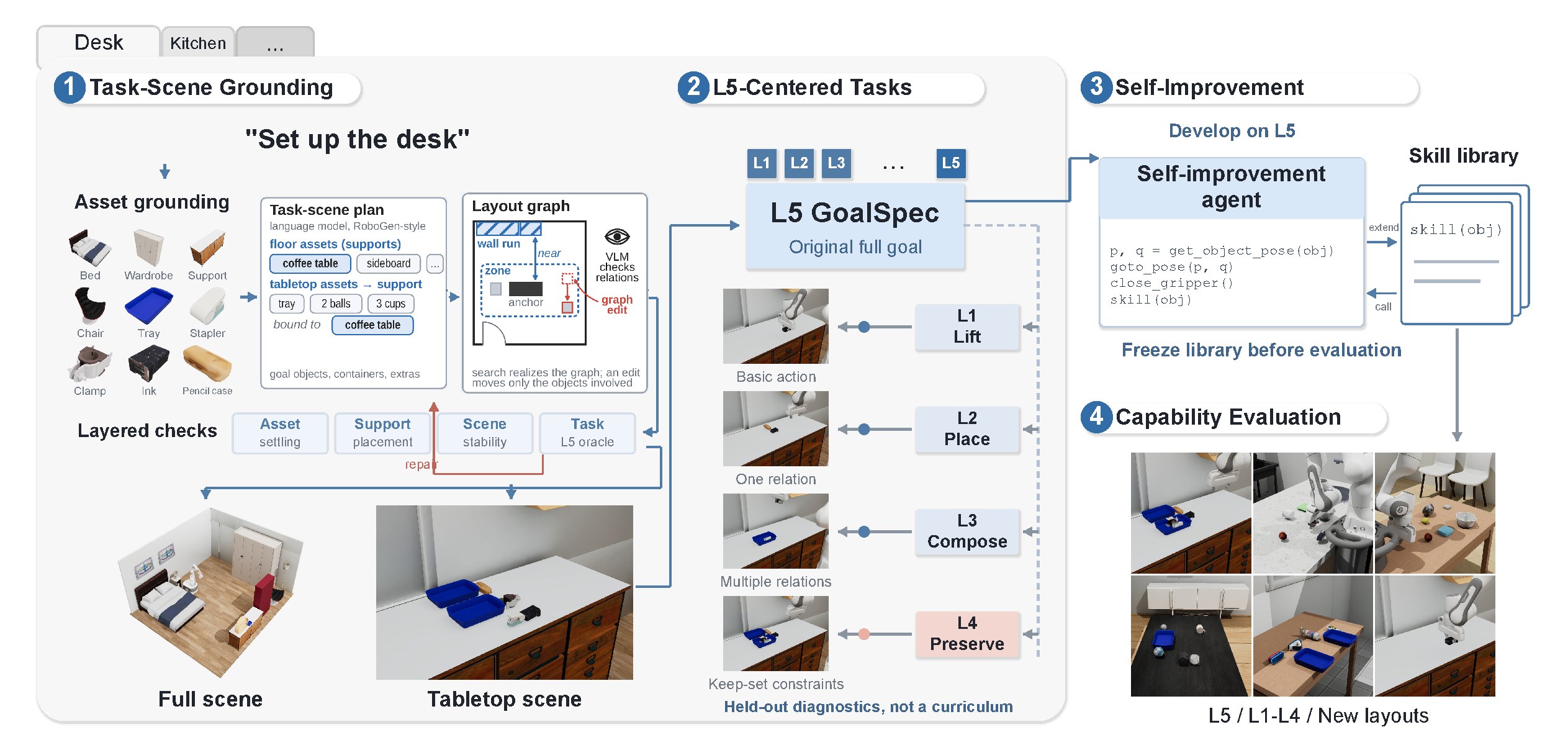
STEPS makes the human goal the unit of evaluation. It generates physically valid, oracle-solvable task scenes from the goal, compiles the full goal into an L5 task, and derives held-out L1–L4 tasks from the same objects and relations. The agent develops its skill library on the goal; then the library is frozen and tested on the practiced task, on regenerated instances, and on the held-out tasks.

Framework

One goal, a ladder of held-out tests.

STEPS compiles the full goal from verified relation templates and derives held-out probes from the same objects and relations. The hierarchy is a measurement axis, not a curriculum.

01 / GROUND

Generate the task scene

A language model plans supports and the goal objects bound to them; floor assets follow zones and wall runs, and graph-edit correction fixes only the objects a VLM flags. Layered checks and a privileged oracle accept the scene.
02 / DERIVE

Compile L5, derive L1–L4

Goal relations from verified templates define the L5 success condition. L1–L4 tasks start from the L5 poses and are labeled goal subtask, component probe, or constraint probe.

03 / FREEZE

Develop, then freeze

The agent develops its skill library on L5 without restriction. The frozen agent is then evaluated on L5, regenerated instances, and the held-out L1–L4 tasks.

L1
Action

Lift or push one goal object.

L2
Relation

Satisfy one object's relation in a reduced scene.

L3
Composition

Satisfy several relations in a reduced scene.

L4
Preservation

Combine groups in the full scene; keep others in place.

L5
Full goal

Complete the human-specified goal.

Every derived task starts from its L5 object poses, so a failure cannot be blamed on a harder layout.

Goal subtasks

Relations that every successful L5 solution also satisfies.

Component probes

Capabilities that L5 solutions exercise but L5 success does not reveal.

Constraint probes

Extra preservation or geometry requirements the goal does not impose.

STEPS pipeline on the office goal: task-scene grounding, L5-centered tasks, self-improvement, capability evaluation
Overview of STEPS on the office goal (paper Fig. 2). The library is developed on L5 only, then frozen before the capability tests.

Human-directed task scenes

A goal becomes a scene the robot can act in.

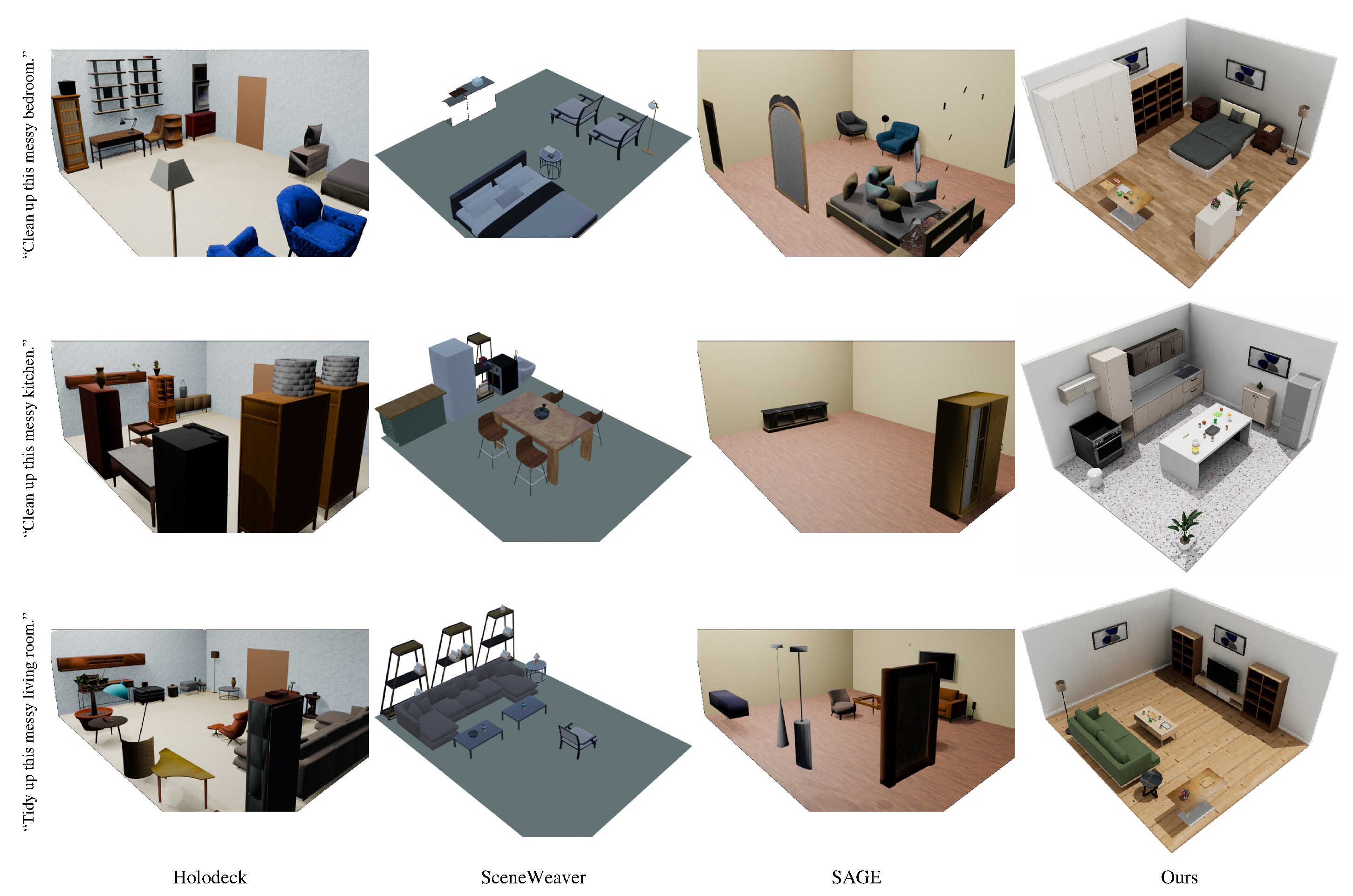
Compared with Holodeck, SceneWeaver and SAGE on the same clean-up instructions ( scenes per method and room), STEPS is the only method without colliding objects in all three room types.

mean ± s.d. over 10 scenes

Visual scores (1–10) by a separate evaluator model; Coll. = % of object meshes in collision (lower is better); Stab. = % of objects stable after 120 simulation steps.

Layered validation

01

Asset settling. Each movable asset is dropped from 2 mm and must settle within 15° and 5 cm.

02

Scene at rest. After 2 s no object moves more than 5 cm or tilts more than 10°, and nothing interpenetrates by more than 5 mm.

03

Oracle solvability. A privileged oracle must solve the task in at least two of three seeds from non-trivial initial states.

04

Regeneration. The accepted scene is frozen and regenerated under controlled pose perturbations.

Scenes generated from the same instruction by Holodeck, SceneWeaver, SAGE and STEPS
Scenes generated from the same instruction, one per method and room type (paper Fig. 3).

Skill Library

The frozen external skill library.

Five executable bundles developed with human assistance in the five task scenes, frozen by SHA-256 before evaluation; eight geometry cards that carry their geometric knowledge to RoboSuite and LIBERO over six primitives; and the skills one evolution route distilled from L1–L4 practice.

Task scenesFive goals, developed on the full L5 task with human assistance.
freeze
Executable bundlesCallable Python over the scene API; object-bound, hash-pinned.
abstract
Geometry cardsBindings removed; injected verbatim into RoboSuite and LIBERO prompts.

Benchmarks

High practice scores, measured gaps, real transfer.

Results on the STEPS benchmark, under pose perturbation, along one evolution route, and on two external benchmarks. Protocols differ across benchmarks; denominators are reported within each and never pooled.

STEPS benchmark · 525 trials

The library saturates L5, but held-out levels fall away.

Frozen library (STEPS) against ASPIRE and CaP-Agent0 on all 105 tasks, five trials each. L5 reaches while L3 goal compositions and L4 constraint probes drop to and .

Q1 + Q2 · Regenerated instances

The L5 score does not survive modest pose changes.

After freezing the library, movable objects are perturbed and invalid or already-solved instances rejected. Under a fixed runtime, L3 goal subtasks reach against at L5, and restating the full goal in the task template gives .

L5 success, frozen agentbars: successes / trials · whiskers: 95% Wilson
Fixed runtime: L5 vs. its L3 goal subtasks

L5 pools two reruns of the five L5 tasks (20 trials per room each); each L3 task has 7 trials. Living room excludes two coordinate probes.

Q3 · Stage records

Distilled skills pass validation, but are rarely executed at the goal.

On one evolution route, skills distilled from L1–L4 practice are traced from proposal to execution. Of L5 trials where they were offered, they were executed unmodified in ; the route's L5 success was .

RoboSuite · beyond the source scenes

Frozen cards transfer; stage records target the next update.

A Code-as-Policy agent with the frozen geometry cards, one program per task run on 50 initial states, compared with RATs. Outlined extensions show the targeted capability update.

Seven RATs tasks
/
vs. RATs
Six Pick-and-Place tasks
/
vs. RATs
After targeted updates (Pick-and-Place)
/
up from · PickPlaceCan → / 50
Recorded trials

Clips come from the frozen-card batches whose totals are reported in the table (one recorded trial each; videos are time-compressed by the recorder). Spill wiping plays at 4×.

Q4 · Same initial state

A capability update recovers a failed execution.

Weak predicates found by the stage records became valid derived long-horizon probes, of which the frozen library solved . Repairs learned from those failures then transfer to RoboSuite without further adaptation.

LIBERO-PRO

Framework adaptation across object, goal and spatial suites.

Success under initial-position (Pos.) and task (Task) perturbation. In a matched pilot on two RoboSuite and two LIBERO tasks, adding the cards raises success from to .

LIBERO-PRO clips are saved-action replays on development seeds from an earlier skill revision (the burned-in banner says so); they illustrate the tasks, not the reported numbers.

Interpretation

Measure the gap before claiming improvement.

Diagnosis, not a solution

STEPS diagnoses self-improvement but does not solve it: no tested evolution route yet reliably improves goal-level performance.

Human-assisted development

The strongest source library was developed with human assistance; it is evidence of execution reuse, not of autonomous skill discovery.

Protocols are not interchangeable

Five-room, RoboSuite and LIBERO-PRO trials use different models, interfaces, budgets and predicates, so their denominators are reported within each protocol.

Abstract

Evaluating self-improvement on human goals.

@inproceedings{steps2027,
  title     = {STEPS: Scene-Grounded Task Escalation through Progressive Skill Learning toward Open-Ended Goals},
  author    = {Anonymous},
  booktitle = {Submitted to the International Conference on Learning Representations (ICLR)},
  year      = {2026},
  note      = {Under double-blind review}
}